

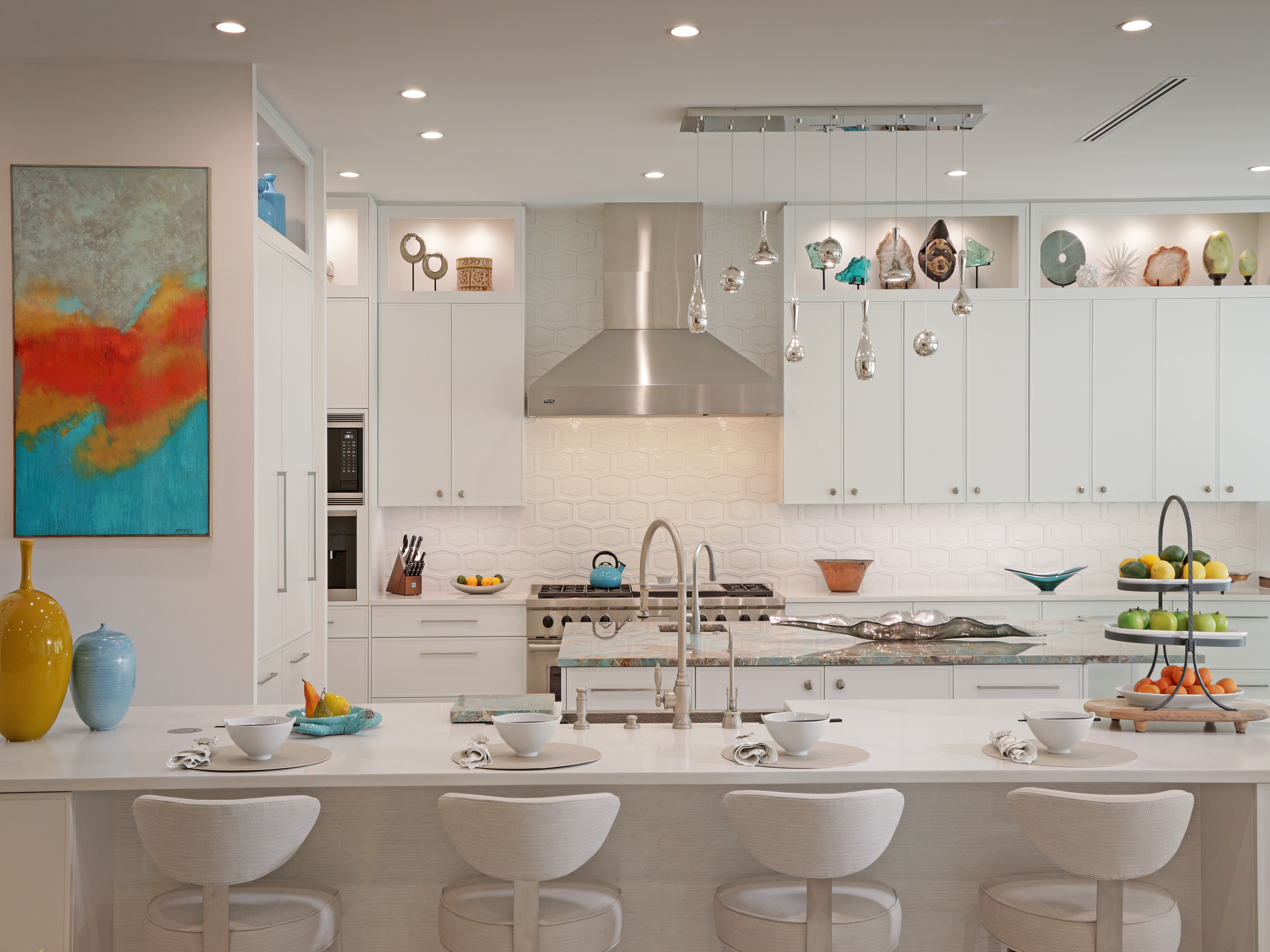
The Gulf Coast is one of the most demanding environments on earth for residential cabinetry. Salt air, year-round humidity, and intense UV exposure combine to degrade materials that perform perfectly in a standard interior but fail quickly in a coastal Florida home. After 42 years specifying luxury cabinets on Siesta Key, Longboat Key, and throughout the Sarasota region, the pattern is consistent: the cabinetry that holds up is the cabinetry that was specified correctly from the beginning.
This guide breaks down every material component of a coastal cabinetry system, what to specify, what to avoid, and why each decision matters more within a mile of the Gulf than it does anywhere else.
The Coastal Cabinet Material Guide for Sarasota and Siesta Key Homeowners
The Core Challenge: What Salt Air and Humidity Actually Do to Cabinetry
Salt air is corrosive. It attacks metal hardware at the microscopic level, causing drawer slides and hinges to seize, rust, or fail within a few years in an improperly specified installation. Humidity causes wood substrates to expand and contract repeatedly, which stresses joints, causes delamination in low-quality plywood, and eventually warps cabinet doors and frames. UV exposure from Florida's intense sunlight bleaches finishes and degrades the adhesives used in veneer applications.
None of these failure modes are inevitable. They are the result of using interior-grade materials in a coastal environment. The solution is straightforward: specify correctly from the start.
Component 1: Cabinet Substrates
The substrate is the structural core of every cabinet box. It is the material you never see, and it is the material that determines whether the cabinet holds its shape and integrity for decades or begins to swell and delaminate within a few years of coastal exposure.
- Specify: Marine-grade plywood or moisture-resistant engineered core. Marine-grade plywood uses waterproof adhesive throughout, with no voids in the inner plies that can trap moisture and cause delamination. Moisture-resistant engineered cores are the standard in quality North American cabinetry lines and perform reliably in high-humidity environments.
- Avoid: Standard particleboard or MDF as the primary substrate in any cabinet that may experience humidity fluctuation, particularly in kitchens, bathrooms, or areas near exterior doors or windows.
Expert InsightIn our Siesta Key and Longboat Key projects, we specify moisture-resistant cores as a baseline requirement regardless of the cabinet line. The substrate is the unseen investment that protects everything above it.
Component 2: Cabinet Finishes
The finish is the cabinet's primary defense against humidity and UV exposure. A single-coat paint or stain applied over unsealed wood is not a coastal finish. It is a finish that will fade, crack, and allow moisture penetration within a few seasons of Florida exposure.
- Specify: Multi-layer catalyzed finishes applied over properly sealed substrates. Industrial-grade lacquers and conversion varnishes provide a hard, moisture-resistant film that seals the wood against humidity penetration and resists UV fading significantly better than standard residential paint finishes.
- Avoid: Single-coat or low-build finishes, particularly on doors and drawer fronts that receive direct sunlight or humidity exposure near windows or exterior openings.
In the Siesta Key Masterpiece project, the slab doors finished in Benjamin Moore La Paloma Gray and Wrought Iron were specified with a multi-layer catalyzed lacquer system to ensure long-term color stability and resistance in a direct Gulf-front environment.
Component 3: Hardware and Mechanisms
Hardware failure is one of the most common complaints in coastal cabinetry that was not properly specified. Drawer slides that stick, hinges that rust, and pulls that corrode are not a finish quality problem — they are a materials specification problem.
- Specify: 316 marine-grade stainless steel for all drawer slides, hinges, and pulls in coastal applications. Grade 316 contains molybdenum, which provides significantly superior corrosion resistance compared to standard 304 stainless. Soft-close mechanisms from manufacturers like Blum are engineered to tight tolerances that maintain smooth operation even in high-humidity conditions.
- Avoid: Standard chrome or zinc-plated hardware, which corrodes quickly in salt air environments. Even hardware marketed as "stainless" should be verified as 316-grade rather than the more common 304 specification.
What to AvoidStandard 304 stainless and zinc-plated hardware are the most common material mistakes in coastal cabinetry installations. The cost difference between 304 and 316 stainless is minimal at the project level. The performance difference over 10 years of Gulf Coast exposure is not.
Component 4: Wood Species and Veneer Selection
Not all wood species perform equally in a high-humidity coastal environment. Dimensional stability — the degree to which a wood species resists expansion and contraction with moisture changes — varies significantly between species and cutting methods.
| Material | Coastal Performance | Project Example |
|---|---|---|
| Rift Sawn Walnut | Excellent. Tight linear grain is more dimensionally stable than flat-cut walnut. Natural oils add inherent moisture resistance. | Siesta Key Masterpiece kitchen and wet bar |
| Cumaru Veneer | Excellent. Naturally dense and oily hardwood with superior resistance to moisture and humidity. One of the most stable tropical species available. | Contemporary Longboat Penthouse kitchen and bar |
| Rift Sawn White Oak | Very good. Fine linear grain and moderate natural tannin content provide good moisture resistance when properly sealed. | North Longboat Spectacular and Longboat Key Beauty |
| Textured Melamine | Good. Non-porous surface resists moisture penetration. No grain movement. Ideal for budget-conscious coastal applications. | Longboat Key Villa kitchen |
| Flat-Cut Exotic Veneers | Variable. Requires careful species selection and multi-layer finish sealing. Some species perform well, others are prone to checking and movement. | Specify with professional guidance only |
The Contemporary Longboat Penthouse project demonstrates Cumaru veneer's exceptional coastal performance. The dense, naturally oily wood was applied to all base cabinetry and island panels, and years after installation it continues to perform without the swelling, checking, or finish degradation that would affect a less suitable species in the same environment.
For our full range of kitchen cabinet and bathroom cabinet options suited to coastal environments, our 3,500 square foot Sarasota showroom carries full material samples across all specifications discussed here. See how these materials perform in real completed projects at our project portfolio.
The Coastal Cabinetry Specification Summary
For any cabinetry project on Siesta Key, Longboat Key, or within close proximity to the Gulf, the minimum specification standard should include:
- Moisture-resistant or marine-grade plywood substrate throughout
- Multi-layer catalyzed finish system with UV-stable topcoat
- 316 marine-grade stainless steel for all drawer slides, hinges, and hardware
- Dimensionally stable wood species or veneer selection verified for coastal performance
- Full perimeter sealing of all cabinet boxes, including backs and bottoms
These specifications are standard practice in our Sarasota property renovations and have been validated across 42 years of completed projects in some of Southwest Florida's most demanding coastal environments.
Frequently Asked Questions
What type of cabinet hardware is best for Siesta Key and Longboat Key homes?
316 marine-grade stainless steel is the correct specification for all drawer slides, hinges, and pulls in coastal Southwest Florida. It contains molybdenum, which provides superior corrosion resistance compared to standard 304 stainless or chrome-plated hardware. This applies to any cabinetry within proximity of salt air, regardless of whether the home is directly on the water.
How does humidity affect custom cabinets in Sarasota and coastal Florida?
Humidity causes wood substrates to expand and contract with seasonal and daily moisture changes. In improperly specified cabinetry, this leads to warped doors, stressed joints, and delamination of low-quality veneers or substrate materials. Specifying moisture-resistant cores, sealed substrates, and dimensionally stable wood species eliminates this failure mode in all but the most extreme exposure conditions.
Are there wood species better suited to Siesta Key and Gulf Coast cabinetry?
Yes. Rift-sawn cuts of walnut and white oak offer superior dimensional stability compared to flat-cut alternatives. Cumaru, a dense tropical hardwood, is among the most moisture-resistant veneer species available and has been used successfully in several EuroTech Longboat Key projects. Textured melamine is a non-porous, stable alternative for applications where wood grain appearance is less critical than performance.
Do all cabinet finishes perform the same in a coastal Florida environment?
No. Single-coat or low-build paint finishes degrade quickly under Florida UV exposure and do not provide sufficient moisture resistance for coastal environments. Multi-layer catalyzed finishes, industrial-grade lacquers, or conversion varnishes applied over properly sealed substrates are the correct specification for Siesta Key, Longboat Key, and Sarasota coastal homes.
Planning a Coastal Renovation? Start with a Free EuroTech Consultation